Updates to the Steam package

I’ve reviewed and updated the steam package to be noarch and no longer i686. As some of you are aware, since a few releases, the client is fully 64 bit, including supporting libraries, and it just ships some libraries and components for the integration on the 32 bit games (Steam overlay, etc.). This does not make 32 bit support optional, it’s still required to actually start the client.

As part of the change, I’ve also reviewed all the libraries and binaries that are required and the libraries that can be overridden. For those of you that are not aware, it works roughly like this:

  • libc.so.6/libdrm.so.2/libGL.so.1/libnsl.so.1 are the only real required libraries for installing on i686 and x8_64.
  • The rest can be considered “improvements” (additional hardware options compiled in specifically for Fedora, graphics drivers, specific distribution bugfixes, etc. – the list is quite long). Steam prefers the local libraries if available.
  • Some libraries are hardcoded (“pinned”) to be consumed only from the Steam Runtime, so even having those installed does not make any difference.

Long story short, I cross checked everything and I’ve revamped the SPEC file to be x86_64 centric with some i686 libraries pulled in as a dependency where it makes sense.

The SPEC file is smaller and tidier. Also for reasons I don’t understand, I can have the noarch package upgrade over i686, but not the same behaviour with x86_64 on i686. Anyway I think it makes more sense to have it noarch for the coming aarch64 variant or the steamrt3c runtime becoming the default.

This is how it will look like:

$ sudo dnf update steam
Updating and loading repositories:
Repositories loaded.
Package               Arch    Version              Repository      Size
Upgrading:
 steam                noarch  0:1.0.0.85-7.fc44    fedora-steam    19.4 MiB
   replacing steam    i686    0:1.0.0.85-6.fc44    fedora-steam    19.4 MiB

Transaction Summary:
 Upgrading:          1 package
 Replacing:          1 package

Total size of inbound packages is 19 MiB. Need to download 19 MiB.
After this operation, 0 B extra will be used (install 19 MiB, remove 19 MiB).
Is this ok [y/N]: 

NVIDIA driver 580 LTS repository

Soon we will get a release of drivers in the 590 branch. So branch 580 will be the last driver branch to support Maxwell, Pascal, and Volta based GPUs.

There is now a long term support for the 580 branch of NVIDIA drivers along with the main one. This repository contains only the 580 driver set in both DKMS and akmod format for supported Enterprise Linux (EPEL) and Fedora releases.

My plan is to maintain this repository until branch is End of Life, which should be around June 2028.

Until then, I’ll try to keep it in sync with the latest changes and updates going into the main repository.

To install this repository on Fedora:

# cd /etc/yum.repos.d
# wget https://negativo17.org/repos/fedora-nvidia-580.repo

On Red Hat Enterprise Linux and derivatives:

# cd /etc/yum.repos.d
# wget https://negativo17.org/repos/epel-nvidia-580.repo

As usual, the EPEL repository is required for Red Hat Enterprise Linux 8 and above.

The open source kernel modules have been removed, as they are not supported on Maxwell, Pascal and Volta GPUs. This makes the kernel module packages smaller and just with the modules supporting this hardware.

Starting with branch 590 the only use case for closed source modules on GPUs that are also supported by open modules is the vGPU case, which anyway as a matrix of supported driver versions and distributions. So starting from 590 I’ll remove the closed source modules and just stick with the open ones from then on.

If you plan to use the Multimedia repository as well, which contains 590 drivers, you can increase the priority of the NVIDIA 580 driver packages on Fedora (DNF5) with:

# dnf config-manager setopt fedora-nvidia-580.priority=90

or on EPEL (DNF4) with:

# dnf config-manager --save --setopt=epel-multimedia.priority=90

Source code stuff is available on Github as usual.

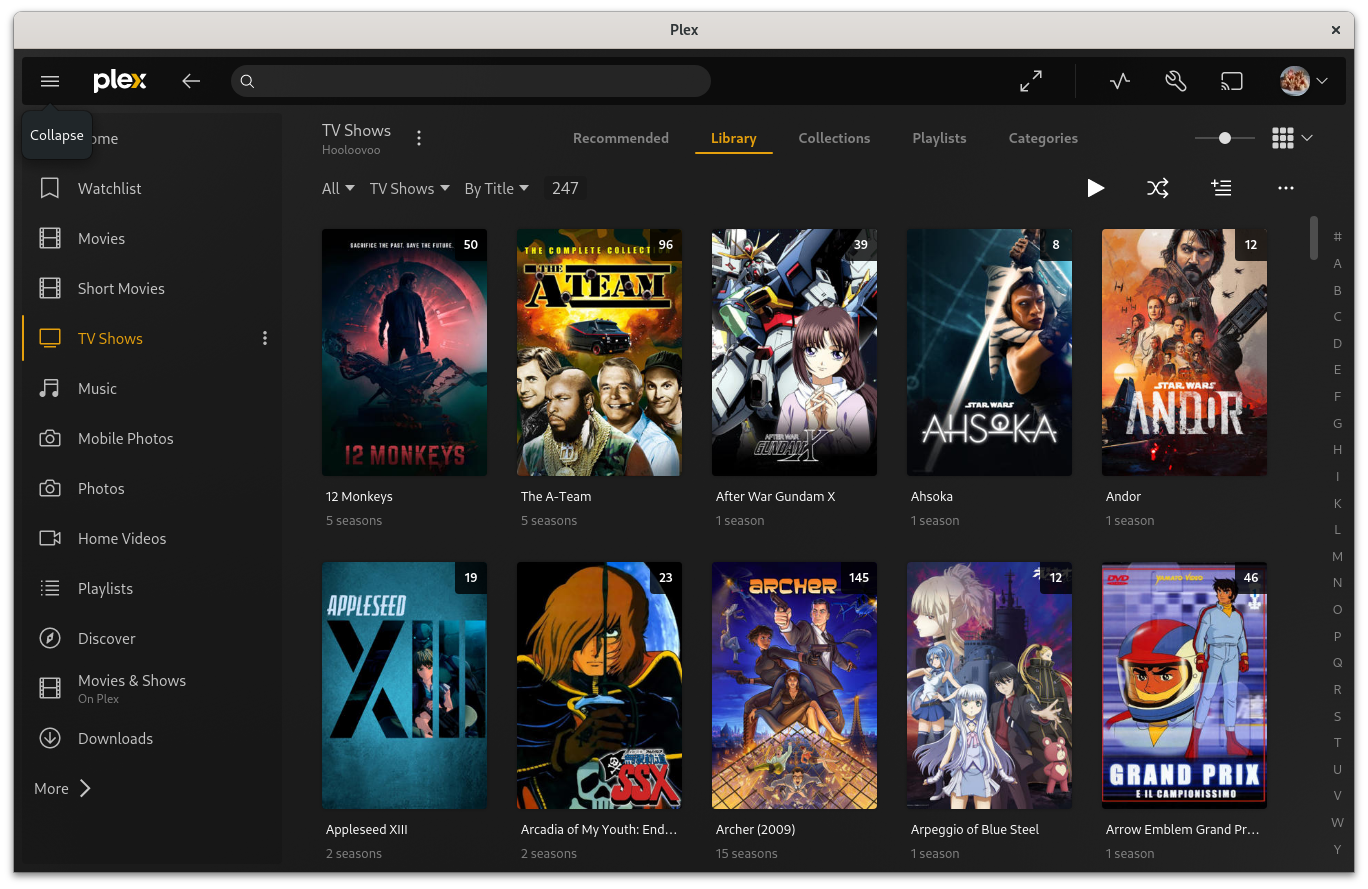
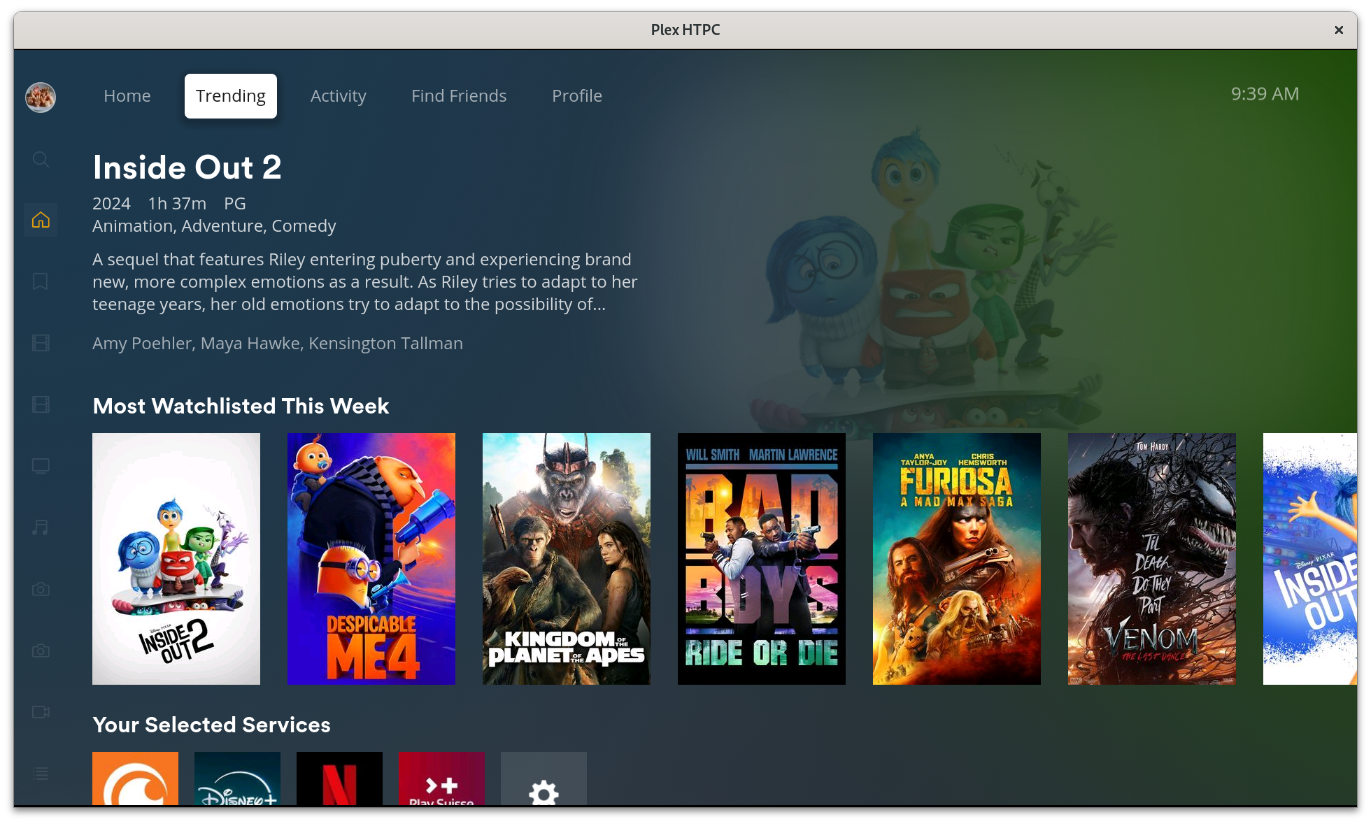
Plex desktop and HTPC client

Plex Desktop and HTPC clients are available again. Now Plex ships a precompiled QT 6 libraries with the private API enabled that allows for an easy packaging. The packages are available for EL9+ and Fedora on the x86_64 architecture only.

Just install the one you need via DNF. For the desktop application:

# dnf -y install PlexDesktop

For the HTPC application:

# dnf -y install plexHTPC

The packages come with every possible system library in use and can be installed in parallel. They both suggest all the VA-API drivers available in the multimedia repository.

Keep in mind that both sport MPV as the main player, so you can still customize the player options as you see fit. For example to force NVIDIA’s hardware decoding in both applications:

$ cat .local/share/plex/mpv.conf
hwdec=nvdec

The HTPC optional package that creates an auto starting “HTPC session” for set top box media players is not restored yet, I will add it in the next days.

The packages bundle QT 6 (for the web interface engine) with the private API enabled, FFMPeg with a progress API status reporting, a custom MPV and a CEC library in the HTPC client.

Why not using the official Flatpak installation directly? First of all I don’t like all the mounting and folder redirection of Flatpak, but also:

# flatpak install tv.plex.PlexDesktop tv.plex.PlexHTPC
Looking for matches…
Required runtime for tv.plex.PlexHTPC/x86_64/stable (runtime/org.freedesktop.Platform/x86_64/23.08) found in remote flathub
Do you want to install it? [Y/n]: y

tv.plex.PlexHTPC permissions:
ipc network pulseaudio x11 devices dbus access [1]

[1] org.freedesktop.PowerManagement, org.freedesktop.ScreenSaver

tv.plex.PlexDesktop permissions:
ipc network pulseaudio x11 devices dbus access [1]

[1] org.freedesktop.ScreenSaver


ID Branch Op Remote Download
1. org.freedesktop.Platform.GL.default 23.08 i flathub < 172.2 MB
2. org.freedesktop.Platform.GL.default 23.08-extra i flathub < 172.2 MB
3. org.freedesktop.Platform.GL.nvidia-555-58-02 1.4 i flathub < 305.0 MB
4. org.freedesktop.Platform.Locale 23.08 i flathub < 360.2 MB (partial)
5. org.freedesktop.Platform.openh264 2.2.0 i flathub < 944.3 kB
6. org.freedesktop.Platform 23.08 i flathub < 227.5 MB
7. tv.plex.PlexHTPC stable i flathub < 150.9 MB
8. tv.plex.PlexDesktop stable i flathub < 149.2 MB

Proceed with these changes to the system installation? [Y/n]:

That’s a whopping 1.5 GiB compressed download compared to the package footprint:

$ ls -1hs Plex*
106M PlexDesktop-1.96.0.177-3.fc40.x86_64.rpm
105M PlexHTPC-1.64.0.170-2.fc40.x86_64.rpm

That’s more than 7 times the size. Flatpak applications with duplicate libraries everywhere are not really my taste.

CUDA with unsupported GCC versions

When running the CUDA stack on a recent Fedora distribution, you’re very likely to hit the compatibility issue with the current GCC release not being yet supported by NVCC. This is quite easy to address, but not many people seem to know it.

At the moment of writing, CUDA 12.4 has GCC 13.x support, while Fedora 40 ships with GCC 14.

Since a few years I’ve been shipping a cuda-gcc package which appears as a drop in replacement for NVCC. It can be installed along with CUDA and the drivers from the Nvidia or multimedia repository or from a Fedora COPR if you are running the upstream CUDA packages provided by Nvidia.

This GCC version is hidden from the main path and is explicitly used by NVCC when compiling something. Installing the cuda-gcc-c++ package creates profile entries in /etc/profile.d that just do this:

# dnf -y install cuda-gcc-c++
$ cat /etc/profile.d/cuda-gcc.sh 
export NVCC_PREPEND_FLAGS='-ccbin /usr/bin/cuda'

Logout/login or reload your profile and you’re good to go.

This way, every time you invoke NVCC you are not using the system compiler but the one provided by the cuda-gcc package.

On a Red Hat Enterprise Linux based distribution you can achieve the same result by installting the development toolset of your choice and activating the environment for it. This is usually not an issue as NVCC is officially supported on those distributions.

Nvidia proprietary and open source kernel modules

With the latest bunch of updates to the Nvidia and Multimedia repositories, I’ve added the ability to switch to the two implementations of the kernel modules currently available in the Nvidia driver for Linux.

Since almost a year, the Nvidia driver ships with two different implementations of the kernel modules, one proprietary and one open source. The open source one as of drivers 545.x is now considered beta quality also for the workstations, so it seems a good moment to start shipping it.

The open source one is supposed to be the only one that will be kept in the future, but at the moment both are available and both differ in terms of functionality. You can read about the main differences in terms of functionality and what chips they support in the official documentation.

I did not want to introduce another variation of the kernel modules beside akmods, kABI and DKMS, this would have created even more confusion and lots of dependencies in the SPEC files for the variations. The new akmod and DKMS packages ship both sources (MIT/GPL and proprietary kernel modules) and allow you to switch between one or the other through a configuration file.

Considering that in the long run only the open source variant will remain, I wanted to make this as transparent as possible for the users. Basically, if you don’t care and just want something that works, nothing has changed for you.

The two sources get referenced as they are referenced inside the Nvidia run file, namely “kernel” for the original proprietary kernel modules and “kernel-open” for the new open source variation.

The following instructions show you how to switch between one implementation or the other.

DKMS

Check which version you have installed:

# modinfo -l nvidia
NVIDIA

Change the type of modules you want to use and trigger a rebuild and a reinstall:

# sed -i -e 's/kernel$/kernel-open/g' /etc/nvidia/kernel.conf
# dkms build -m nvidia/545.29.02 --force
# dkms install -m nvidia/545.29.02 --force

Now check again the license and you should see that it has changed to MIT/GPL:

# modinfo -l nvidia
Dual MIT/GPL
# reboot

To switch back, change the configuration again and then trigger the same process for rebuilding installing:

# sed -i -e 's/kernel-open$/kernel/g' /etc/nvidia/kernel.conf
# dkms build -m nvidia/545.29.02 --force
# dkms install -m nvidia/545.29.02 --force
# reboot

akmods

Check which version you have installed:

# modinfo -l nvidia
NVIDIA

Change the type of modules you want to use and trigger a rebuild and a reinstall:

# sed -i -e 's/kernel$/kernel-open/g' /etc/nvidia/kernel.conf
# akmods --rebuild

Now check again the license and you should see that it has changed to MIT/GPL:

# modinfo -l nvidia
Dual MIT/GPL
# reboot

To switch back, change the configuration again and then trigger the same process for rebuilding installing:

# sed -i -e 's/kernel-open$/kernel/g' /etc/nvidia/kernel.conf
# akmods --rebuild
# reboot

CUDA 9.0, cuDNN 7.0 and Wayland support in Fedora 27

The Nvidia repository now contains packages for Fedora 27. This is with the release candidate of CUDA 9, and it contains also cuDNN at version 7.0, which is the only version supported with CUDA 9 at the moment of writing.

The updated cuDNN 7.0 library has been added also to the other branches, this means it will be automatically upgraded from version 6.0 to 7.0. If you still need one of the previous versions, just remove it and install one of the compatibility packages:

# dnf list cuda-cudnn*
Installed Packages
cuda-cudnn.x86_64                   1:7-1.fc26         @fedora-nvidia
Available Packages
cuda-cudnn-devel.x86_64             1:7-1.fc26         fedora-nvidia 
cuda-cudnn5.1.x86_64                1:5.1-2.fc26       fedora-nvidia 
cuda-cudnn5.1-devel.x86_64          1:5.1-2.fc26       fedora-nvidia 
cuda-cudnn6.0.x86_64                1:6.0-1.fc26       fedora-nvidia 
cuda-cudnn6.0-devel.x86_64          1:6.0-1.fc26       fedora-nvidia 

CUDA 9 supports GCC 6.x and CLANG 3.9, so when it will be officially released, it will cover Fedora 25 and RHEL/CentOS compilers. With Fedora 27, there will be the usual need for a GCC compatibility package (like the compat-gcc53 package currently in the repository) as GCC is at version 7 and CLANG is at version 4.0.

I will try to provide a compat-gcc64 for Fedora 27+ at the time of the official CUDA 9 release.

Regarding the drivers, on Fedora 27 where Mutter 3.25+ is available, the modesetting part of the Nvidia drivers has been enabled by default, this means that at the login you can just select “GNOME” to run Gnome on Wayland. Please note that X 3D programs running on XWayland might not work properly.

CentOS 7.4 package rebases

As many have requested, I’ve enabled the updates for CentOS 7.4. As of this very moment, you need to enable the Continuous Release repository, which will get emptied when the final CentOS 7.4 images will be released. This means all the temporary packages I’ve put in the Red Hat Enterprise Linux 7.4 repository are now mainline.

If you are on CentOS 7.3 please proceed as follows:

# yum clean all
# yum-config-manager --enable cr
# yum update

You can then disable the cr repository (if you want) once CentOS 7.4 is out.

If you are on RHEL 7.4, you need to remove the temporary repository:

# yum clean all
# rm -f /etc/yum.repos.d/rhel74-temp.repo
# yum update

All Gstreamer packages are now at 1.10 as well as some other updates that have been already pushed into the Fedora repositories, like x265, HandBrake, etc..

RHEL 7.4 multimedia packages and Skype repository removal

The upgrade path from Red Hat Enterprise Linux 7.3 to 7.4 is a bit of a pain if you have the multimedia repository configured. This is because I’m rebuilding a few components for an upgraded libwebp package and because a lot of stuff has been rebased to versions that are in Fedora. Judging by the logs, I see that most of the downloads come from CentOS systems, so I just decided to hold on some updates that are required for the various package rebases for Red Hat Enterprise Linux 7.4. So until also CentOS releases version 7.4, I can’t make everyone happy and something (like Gstreamer plugin updates) will be stuck with 7.3 versions. Hopefully the new CentOS release will come quickly enough.

Also, I decided to stop rebuilding the base packages to use a newer libwebp version. This really had very few benefits and just a lot of pain due to the huge amount of packages involved in both x86_64 and i686 variants. The amount of packages affected by this weigh at around 3 gb.

In RHEL 7.4 there are additional WebKit variants that also would require a rebuild. So, as of today, to update the packages from the EPEL 7 multimedia repository you should run this command:

rpm -e --nodeps GraphicsMagick && yum distro-sync && yum -y install GraphicsMagick

Hopefully you would get an output similar to this:

Dependencies Resolved

==============================================================================================
 Package                         Arch        Version                  Repository         Size
==============================================================================================
Updating:
 compat-ffmpeg-libs              x86_64      1:2.8.12-2.el7           epel-multimedia   5.6 M
 ffmpeg                          x86_64      1:3.3.3-2.el7            epel-multimedia   1.5 M
 ffmpeg-libs                     i686        1:3.3.3-2.el7            epel-multimedia   6.1 M
 ffmpeg-libs                     x86_64      1:3.3.3-2.el7            epel-multimedia   6.3 M
 gstreamer1-plugins-bad          x86_64      1:1.4.5-5.el7            epel-multimedia   1.8 M
 libavdevice                     x86_64      1:3.3.3-2.el7            epel-multimedia    63 k
Downgrading:
 leptonica                       i686        1.72-2.el7               epel-multimedia   881 k
 leptonica                       x86_64      1.72-2.el7               epel              928 k
 libwebp                         i686        0.3.0-3.el7              base              169 k
 libwebp                         x86_64      0.3.0-3.el7              base              170 k
 lz4                             x86_64      1.7.3-1.el7              epel               82 k
 python-pillow                   x86_64      2.0.0-19.gitd1c6db8.el7  base              438 k
 webkitgtk                       x86_64      2.4.9-1.el7              epel               12 M
 webkitgtk3                      x86_64      2.4.9-6.el7              base               11 M
Installing for dependencies:
 libwebp0.6                      i686        0.6.0-1.el7              epel-multimedia   255 k
 libwebp0.6                      x86_64      0.6.0-1.el7              epel-multimedia   250 k

Transaction Summary
==============================================================================================
Install               ( 2 Dependent packages)
Upgrade    6 Packages
Downgrade  8 Packages

Total download size: 47 M
Is this ok [y/d/N]:

Basically libwebp should come again from the main CentOS/RHEL channels and the libwebp0.6 package should come from the multimedia repository. All the packages which were rebuilt for the previous libwebp 0.5 update should become synced again to their proper versions.

If you don’t get this output, but still get some dependency errors you have to do some debugging. For example, ffmpeg-libs.i686 requires libssh.i686, but the version of libssh in CentOS extras is different from the one in EPEL (it really depends on what kind of packages you have installed and with which repositories enabled) so I’m providing here the same version that is in CentOS extras but in both variants.

Update 16th August 2017

If you get many qt5 errors during the transactions, keep in mind that RHEL 7.4 has been rebased massively, and everyone else (including EPEL) is catching up. As of today, if you have the following errors (trimmed down) in a Yum transaction:

Error: Package: gvfs-1.30.4-3.el7.x86_64 (rhel-x86_64-server-7)
Error: Package: qt5-qtwebkit-5.6.1-3.b889f46git.el7.x86_64 (epel)
Error: Package: qt5-qtquickcontrols2-5.6.1-2.el7.x86_64 (@epel)
Error: Package: GraphicsMagick-1.3.26-3.el7.x86_64 (@epel-multimedia)
Error: Package: kf5-kdeclarative-5.36.0-1.el7.x86_64 (epel)
Error: Package: qt5-qtquickcontrols2-5.6.1-2.el7.x86_64 (@epel)
Error: Package: qt5-qtwebkit-5.6.1-3.b889f46git.el7.x86_64 (epel)
Transaction check error:
  file /usr/lib64/gstreamer-1.0/libgstopus.so from install of gstreamer1-plugins-bad-1:1.4.5-5.el7.x86_64 conflicts with file from package gstreamer1-plugins-base-1.10.4-1.el7.x86_64

You can do the following. For this:

Error: Package: GraphicsMagick-1.3.26-3.el7.x86_64 (@epel-multimedia)

Do:

rpm -e --nodeps GraphicsMagick && yum -y install GraphicsMagick

All of the QT7KDE 5 stuff:

Error: Package: qt5-qtwebkit-5.6.1-3.b889f46git.el7.x86_64 (epel)
Error: Package: qt5-qtquickcontrols2-5.6.1-2.el7.x86_64 (@epel)
Error: Package: kf5-kdeclarative-5.36.0-1.el7.x86_64 (epel)

Are in EPEL testing updates, so:

yum --enablerepo=epel-testing update

These:

Error: Package: gvfs-1.30.4-3.el7.x86_64 (rhel-x86_64-server-7)Transaction check error:
  file /usr/lib64/gstreamer-1.0/libgstopus.so from install of gstreamer1-plugins-bad-1:1.4.5-5.el7.x86_64 conflicts with file from package gstreamer1-plugins-base-1.10.4-1.el7.x86_64

are some of the packages that are rebased in RHEL 7.4. I’ve created a temporary repository for those, it will disappear once CentOS 7.4 is released as the packages will be integrated in the main multimedia repository. You can install it through:

yum-config-manager \
  --add-repo=https://negativo17.org/repos/rhel74-temp/rhel74-temp.repo

With the above repository it is possible to install all the other multimedia packages.

Skype repository removal

Skype 4.3 is 32 bit only, is now obsolete and has been superseded by a package that actually lists proper dependencies. It is also one of the packages that required one of the above WebKit rebuilds in i686 form for RHEL/CentOS 7 x86_64.

If you have it installed, just remove it with:

yum remove webkitgtk.i686

The repository has been deleted; to install the new Skype provided version, just head to the following official link.

Big multimedia repository update (CUDA enablements, rebases, new software)

Merging of the Nvidia repository into Multimedia

The whole multimedia repository has been rebased with recent releases, and it now features FFmpeg 3.2 as the foundation. Most of the programs that suppport some Nvidia integration are now enabled and compiled with support for CUDA/NVENC/CUVID; leveraging the previous reorganization of CUDA 8 in the various subpackages.

This means that all the Nvidia packages are now included in the repository as well, so if you have an Nvidia card and you are interested in both repositories, you can just have the multimedia repository enabled. If you still just want the Nvidia stuff (as enabled in Fedora 25) then it’s still available as a separate repository; and that will not change.

Why all of this? Because I can’t keep them separated anymore. The Nvidia repository can exist on its own, but the multimedia one can’t, due to the dependencies and the constant rebases (also of main Fedora and CentOS/RHEL packages). You can use the Nvidia repository alone, if you just need that, or use the multimedia one if you need everything else.

The repository is now exposed also at this URL, and contains Delta RPM support:

https://negativo17.org/repos/multimedia

All repository files and configurations have been updated, so this means that in the future this would be the place where the metadata and repository information will be placed and any new installation will get the repository from there. If you are reading this blog post, you can switch now. I will add a negativo17-release package soon, along with a few mirrors; I’m sorting out the details now with the mirror owners.

FFmpeg and other CUDA enablements

To make proper use of the Nvidia hardware encode features (NVENC/CUVID) and CUDA kernel support (i.e. Blender GPU rendering) in the various programs you need the Nvidia driver installed (nvidia-driver-cuda), and for Nvidia Performance Primitives you require the CUDA driver and the NPP library package (cuda-npp).

This means that for most people NOT requiring CUDA support or not using an Nvidia video card, the following 2 packages will be installed anyway:

$ ls -alghs nvidia-driver-cuda-libs*.rpm cuda-npp*.rpm 
92M -rw-r--r-T. 1 mock 92M Nov 16 12:35 cuda-npp-8.0.44-6.fc25.x86_64.rpm
22M -rw-r--r-T. 1 mock 22M Nov 19 15:00 nvidia-driver-cuda-libs-375.20-1.fc25.x86_64.rpm

Both packages contain just libraries, and they will be on your system as much as other libraries for multimedia codecs you don’t actually need. Example, with most multimedia programs you will get Xvid libraries for opening Xvid files, even though the format is pretty much abandoned. Having them installed does not enable any unwanted feature in your system. Also, NPP libraries should decrease 50% in size in one of the next CUDA updates, being the monolithic version of the library being deprecated in favor of split functionality.

There are some patches being evaluated to make those libraries loadable at runtime, but they have not been merged yet and there’s no guarantee that they ever will. Also, they are available for FFmpeg but not for all the other programs where support has been enabled for; so depending on your installation, you might get them anyway.

As of today, from the Multimedia repository the following programs have been enabled with some Nvidia hardware enablement:

  • MPV (video decoding through CUVID)
  • FFmpeg (encoding through NVENC, decoding through CUVID and filtering through CUDA NPP)
  • Avidemux (encoding, through NVENC)
  • GStreamer (NVENC plugin)
  • Blender (GPU rendering)

VDPAU for decoding was already enabled where possible.
Of course anything that is using FFmpeg (like the GStreamer plugins) could theoretically benefit from the same enablements as in FFMpeg:

$ for i in encoders decoders filters; do
    echo $i:; ffmpeg -hide_banner -${i} | egrep -i "npp|cuvid|nvenc|cuda"
done
encoders:
 V..... h264_nvenc           NVIDIA NVENC H.264 encoder (codec h264)
 V..... nvenc                NVIDIA NVENC H.264 encoder (codec h264)
 V..... nvenc_h264           NVIDIA NVENC H.264 encoder (codec h264)
 V..... nvenc_hevc           NVIDIA NVENC hevc encoder (codec hevc)
 V..... hevc_nvenc           NVIDIA NVENC hevc encoder (codec hevc)
decoders:
 V..... h263_cuvid           Nvidia CUVID H263 decoder (codec h263)
 V..... h264_cuvid           Nvidia CUVID H264 decoder (codec h264)
 V..... hevc_cuvid           Nvidia CUVID HEVC decoder (codec hevc)
 V..... mjpeg_cuvid          Nvidia CUVID MJPEG decoder (codec mjpeg)
 V..... mpeg1_cuvid          Nvidia CUVID MPEG1VIDEO decoder (codec mpeg1video)
 V..... mpeg2_cuvid          Nvidia CUVID MPEG2VIDEO decoder (codec mpeg2video)
 V..... mpeg4_cuvid          Nvidia CUVID MPEG4 decoder (codec mpeg4)
 V..... vc1_cuvid            Nvidia CUVID VC1 decoder (codec vc1)
 V..... vp8_cuvid            Nvidia CUVID VP8 decoder (codec vp8)
 V..... vp9_cuvid            Nvidia CUVID VP9 decoder (codec vp9)
filters:
 ... hwupload_cuda     V->V       Upload a system memory frame to a CUDA device.
 ... scale_npp         V->V       NVIDIA Performance Primitives video scaling and format conversion

I think this will be much appreciated for you users out there that are already using CUDA for deep learning and FFMpeg to process data 🙂

Rebases: FFmpeg, HandBrake, VLC, OpenH264, WebP (CentOS/RHEL), MPV.

A note on Blender: Blender with CUDA support is still at 2.78 built with CUDA 7.5, and not 2.78a built with CUDA 8; so no Nvidia Pascal GPU support. I’m working on it.

GNOME Software integration

Most of the graphical software is now enabled in GNOME software for Fedora 25, meaning that you can search stuff with a keyword and that if you have the repository enabled it will just pop-up:

gnome-software-handbrake

gnome-software-makemkv

gnome-software-vlc

There is still some packages that need AppStream metadata, but that will come.

As usual, feedback, bugs and comments are welcome.